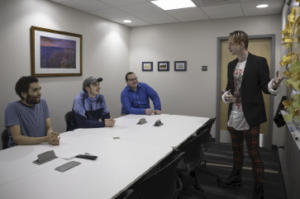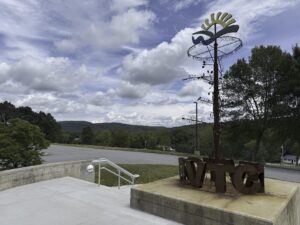

Most people have an outdated vision of manufacturing. The misconception of a dirty, dangerous assembly line—where each worker is an irreplaceable cog in a high-output machine—is far from reality.
Brian Kippen of East Randolph, VT recognizes this as one of the greatest obstacles in the industry.
The entrepreneur, educator, and founder of KAD Prototypes, as well as the owner of HEB Manufacturing, is passionate about the issue.
“There’s a huge difference between what society thinks manufacturing is and what it really is,” said Brian. “The floors are clean, everything’s contained in a box…It’s very different—using computers and automation.”
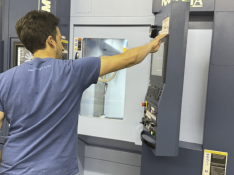
Specializing in Computer Numerical Control (CNC) machining, silicone molding, and urethane casting, KAD Prototypes offers a window into a high-demand industry in Vermont. Yet few students realize the career potential—even with Vermont State University Randolph and the Randolph Technical Career Center just down the road.
Brian is determined to change that, one student at a time.
Recent graduate James Helfant, now part of the KAD team, remembers the learning curve:
“When I first started, it wasn’t very easy, but as I kept going, it kind of just got drilled into my brain. But they don’t really do that in school anymore.”
Both James and Brian stress the importance of repetition for skill retention, noting that most schools aren’t meeting industry needs—even in basic computation.
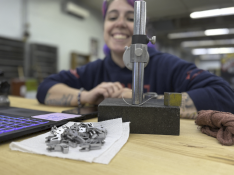
“STEM education is good, but historically, what really stuck was having applicable things,” said Brian, citing the example of cooking in home economics. He’s seen firsthand how purpose and creative problem-solving improve retention.
“STEM education is packaged so it’s easy to deploy.” Brian explained that with room to explore beyond a rigid curriculum, students develop creative solutions to real-world problems—challenges they’d never encounter in a textbook.
The learning, Brian says, never stops. Robb Knudsen, a 12-year HEB team member, agreed:
“Since Brian’s taken over, we’re learning multiple things a day. I was able to expand on what I knew—and what I thought I knew.”
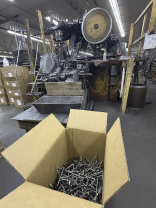
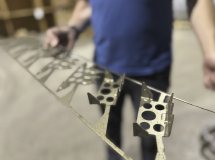
At HEB, the work floor centers on custom wire forms and metal stamping—traditional processes that rely on highly calibrated analog cams, where precisely timed pistons operate in sync with each machine revolution to transform raw materials into specialized components.
From the safety clip on an electrical meter to the toe cleats of a snowshoe, Brian noted that nearly every household in America has a product made in this shop.
Although KAD Prototypes and HEB Manufacturing serve different niches, each with unique processes and skill sets, Brian says the most important qualification is simple: a willingness to learn.
“I don’t care how many college grads you send to me—unless they’ve worked with The Manufacturing Collaborative, you’re still starting at zero, or zero plus interest,” he said.

Located on the campus of Vermont State University in Randolph, The Manufacturing Collaborative has introduced a new model for training advanced manufacturing workers to address hiring shortages.
Executive Director Barry Hulce explained that their public–private model tackles core industry challenges by partnering with institutions and companies to create sustainable pathways that build capacity and skills.
“I wanted to prove the model that people can get paid to learn,” said Barry, reflecting on the concept that guided The Manufacturing Collaborative’s creation five years ago.
Yet, Barry notes, this shift in how workers enter the field depends on awareness.
“The learner’s journey is always awareness, then excitement, then training, then a career. It’s very hard to skip any of those steps.”
Looking back on his time teaching at Randolph Technical Career Center, Brian understands the uphill battle educators face:
“It becomes really difficult if you are the educator, the spokesperson, the recruiter. You’re doing all this work, fighting against a system that basically says career technical education is what you do right before you drop out.”
With leaders like Brian and Barry, Vermont’s manufacturing future is coming into focus for students across the state—a future where creative problem-solving and lifelong learning go hand in hand, and where the technical trades are celebrated with pride throughout the community.
Story and photos by Devan Monette, STRIVE