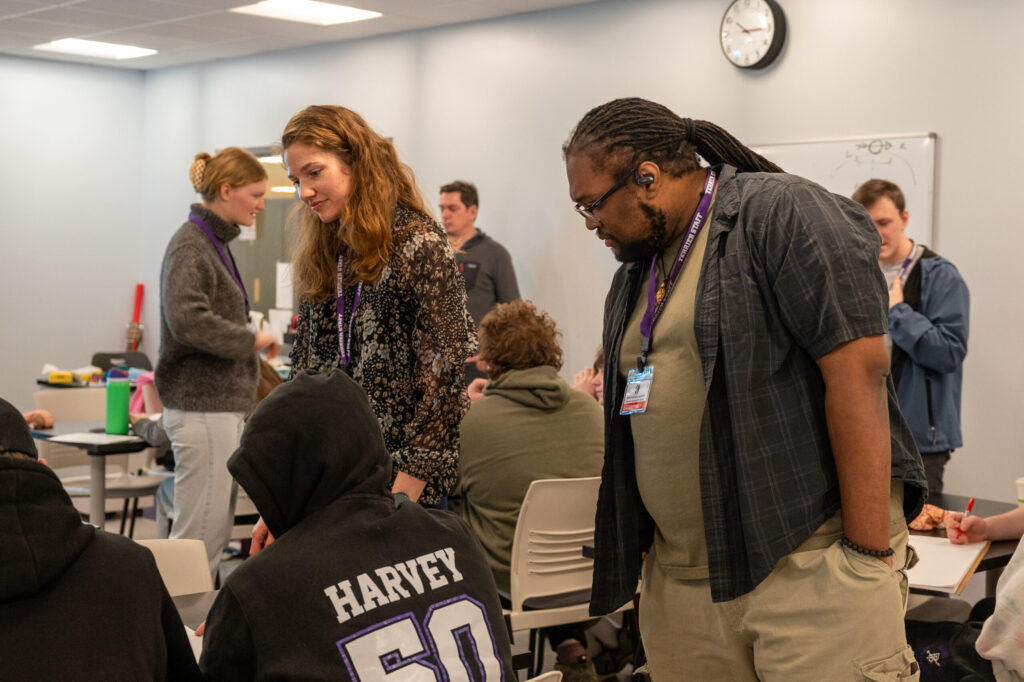
Bellows Falls Union High School students had a special opportunity this last week during Brain Awareness Week, made possible by NSF STRIVE in coordination with Landmark College Institute for Research and Training.
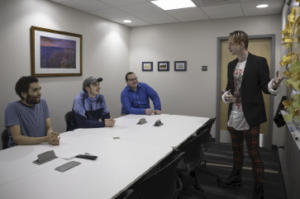
A team of neuroscientists visited four classes to present a workshop titled BrainSTEM, where, together with students, they explored how the brain works in relation to processing signals and shaping our perceptions of the world.
Landmark College Research Scholar Gabrielle Ewall led the initiative with the help of four first-year Dartmouth College Ph.D. students and Landmark College senior Anastasio Bonhomme. Together, they facilitated interactive workshops designed to build awareness and share resources with local students about how metacognitive awareness shapes the way we learn.
To tackle this objective, the first step was to start asking questions.
A short video initiated the conversation with a simple question for the entire room:
What sound did you hear?
A video demonstrating the McGurk effect asked students to state whether they heard ‘va’ or ‘ba.’ The responses varied, with a strong correlation to whether or not participants had their eyes open or closed.
The exercise sparked a cascade of questions and launched the group into an inquiry about how the human brain can perceive two different sounds based solely on the addition of visual input.
“How does the placebo effect start?.” A student spoke from the back row.
“Do we have muscle memory in learning?”Another chimed in.
“Does the brain of someone with ADHD look differently than someone without ADHD?”
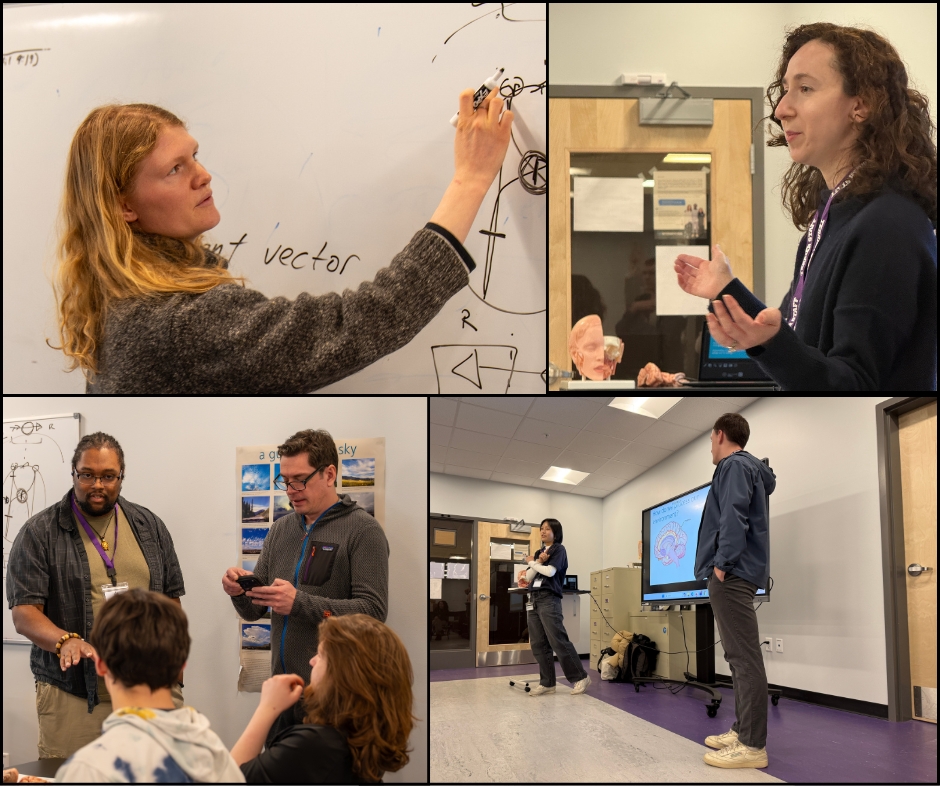
All very good questions. To respond, the team drew from their respective areas of expertise, using scientific reasoning and prior research to guide their answers. At the same time, they modeled an equally important principle: that without sufficient evidence, some questions remain open—inviting hypothesis rather than certainty.
For a generation that has grown up with near-instant access to information at the touch of a screen, the practice of sustained inquiry—asking questions without the immediate promise of answers—became a learning opportunity in itself.
Reflecting on his own learning journey, Anastasio Bonhomme was grateful he was taught from a young age to question. “I was very lucky in that I grew up with parents that encouraged me to question everything around me, including themselves.”
In learning to ask questions, Anastasio described how curiosity helped him make sense of complex systems, drawing connections across ideas to better understand underlying processes. “That led to seeking that deeper understanding and sort of trying to make things connect.”
As the workshop evolved—from questioning perception to examining the neural pathways that shape experience—a central theme began to emerge. Students came to recognize that we all see, hear, and sense the world differently. With that realization came a shared understanding across the room: we also learn differently.
Speaking to the class, Gabrielle Ewall frames this notion with some real life examples.
“The sound of smacking lips or chewing gum, bright lights, and all this other stuff going on can be really overstimulating to one person. For another person, they might feel like they can’t pay attention unless it’s, you know, like fireworks.”
Sparking self-reflection, students continued to ask questions—only now, their inquiries turned inward, grounded in their own lived experiences as learners.
“How come I can sit through an hour of soccer practice but to sit through an hour of class is painful.”
“Why is it so hard for me to concentrate after not getting a good nights sleep?”
“How come I can focus so much more clearly after a walk around the building.”
By the end of the workshop, the focus had shifted from finding the “right” answers to developing stronger questions. In that shift, students were not only learning about the brain—they were learning how to understand themselves. In a classroom built on curiosity, uncertainty became a tool rather than a barrier, and asking thoughtful questions emerged as a critical skill for both science and everyday life.
“People are naturally curious,” said Anastasio, again reflecting on his own learning trajectory. “If somebody has the awareness to ask a question, they have the awareness to receive some kind of answer.”
Story by Devan Monette, Cover photo and additional photos by Guinevere Downey